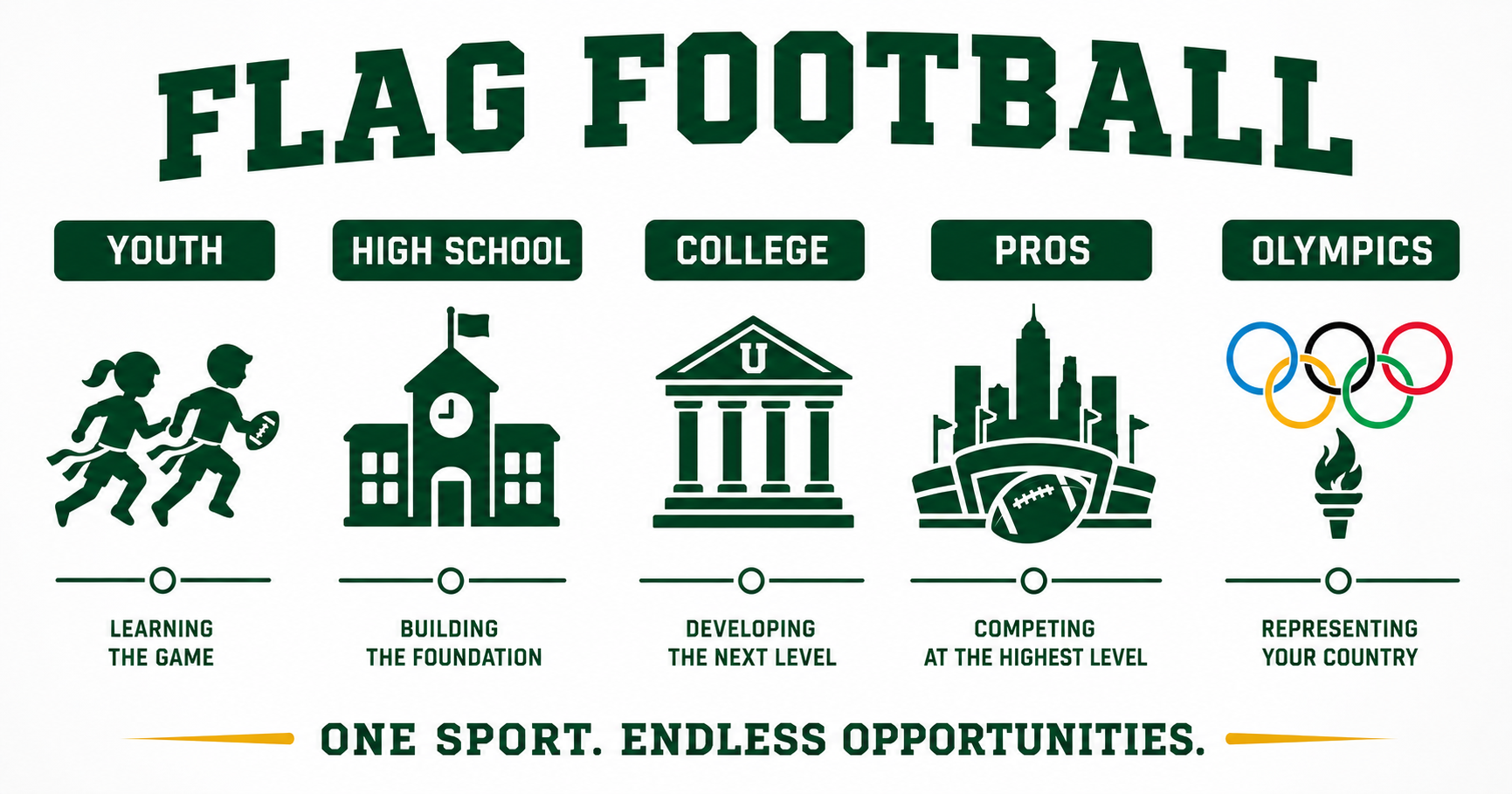
Just a few years ago, flag football was viewed primarily as a recreational sport. Today, it is on of the fastest-growing sports in the world, creating new opportunities for athletes, coaches, schools, and organizations at every level of competition. From the upcoming Olympic Games to NCAA expansion and explosive growth in high schools nationwide, flag football is entering a new era.
The Olympic Effect
The biggest milestone in the sport's history is approaching quickly. Flag football will make its Olympic debut at the 2028 Summer Olympics in Los Angeles, marking the first time the sport will be featured on the world's largest athletic stage. Both men's and women's tournaments will be included, creating unprecedented visibility for the game. The governing body for the United States Olympic team will be USA Football, and the International Federation of American Football (IFAF) with oversee everything to do with the countries competing in the Olympics. National teams around the world are expanding their programs and competing in IFAF games to solidify their spot in the 2028 Olympics. For young athletes, especially girls, the Olympics provide a clear long-term goal. What once seemed like a recreational sport can now lead to representing your country on the world's biggest stage.
The Establishment of Professional Flag Football
Another major development could further accelerate the sport's growth: professional flag football. In 2025, the NFL announced a partnership with TMRW Sports to explore the creation of a professional flag football league featuring both men's and women's competition. The initiative aims to build a premier professional platform for the sport while capitalizing on the momentum created by the 2028 Olympics and the rapid expansion of flag football worldwide. A professional league would provide elite athletes with a pathway beyond college competition, similar to how professional leagues support basketball, soccer, and volleyball players after graduation. For women's flag football in particular, a pro league could create new opportunities for athletes to continue competing at a high level while inspiring the next generation of players. Professional flag football would increase media exposure, attract sponsorship opportunities, create coaching and officiating jobs, and strengthen the sport's overall infrastructure. Combined with Olympic participation, NCAA growth, and expanding high school programs, a professional league could help establish flag football as one of the fastest-growing sports in North America and around the world.
NCAA Momentum Continues to Build
The college landscape is changing rapidly. In January 2026, the NCAA officially added women's flag football to its Emerging Sports for Women program, a major step toward becoming a fully recognized NCAA championship sport. The sport has already surpassed many expectations. NCAA officials reported that approximately 40 schools planned to sponsor flag football at the varsity level during the 2025-26 academic year, with participation expected to continue increasing. Even more significant, the NCAA announced in May 2026 that women's flag football had taken another major step toward championship status, with the first NCAA championship potentially arriving as early as Spring 2028. Schools across the country are launching new programs, creating coaching opportunities, scholarships, recruiting pipelines, and competitive opportunities that did not exist just a few years ago. Nebraska became the first Power Conference school to announce women's flag football as a varsity sport, a move many believe will encourage other major universities to follow.
High Schools Are Driving the Growth
While the Olympics and NCAA receive much of the attention, the foundation of the sport's future is being built in high schools. More states continue to sanction girls' flag football as an official varsity sport, creating thousands of new opportunities for student-athletes. Participation numbers continue to rise as schools recognize the accessibility, affordability, and inclusiveness of the game. NFL teams, state athletic associations, and community organizations have invested heavily in growing the sport at the grassroots level. High school showcases now attract college recruiters, and athletes are increasingly earning scholarship opportunities through flag football. 23 states have sanctioned girls flag football. As more states sanction the sport and more colleges add programs, a complete player development pathway is emerging from youth leagues to high school competition, college scholarships, pro-leagues, national teams, and even Olympic participation.
The Youth Flag Football Explosion
While high school and college flag football continue to make headlines, the sport's biggest growth may be happening at the youth level. Across the United States, youth flag football leagues are experiencing record participation numbers. Communities are adding new leagues, expanding age divisions, and creating opportunities for both boys and girls to learn the game at an early age. Parents are increasingly drawn to flag football because it offers many of the same skills and excitement as traditional football while emphasizing speed, agility, teamwork, and strategy in a non-contact environment. The NFL and USA Football have played a significant role in fueling this growth through NFL FLAG, which has become one of the largest youth sports programs in the country. Thousands of young athletes now participate in local, regional, and national tournaments each year, with many dreaming of one day competing in college, professionally, or even at the Olympics. There are over 7.1 million flag football players across the U.S, with the NFL estimating a 50% jump in youth players since 2020. NFL FLAG: As the largest U.S. league, NFL FLAG serves over 620,000 youth athletes (ages 4-17) across all 50 states.
The next few years could be transformational for flag football. Over the past few years, Flag Football has became a complete development pathway: youth leagues, high school competition, college scholarships, national teams, professional opportunities, and Olympic dreams. By 2028, the sport could feature an Olympic tournament, an NCAA championship, expanded high school participation nationwide, and a growing professional presence. Few sports have experienced this level of momentum in such a short period of time. By 2028, the sport could feature an Olympic tournament, an NCAA championship, expanded high school participation nationwide, a thriving youth pipeline, and a growing professional presence.