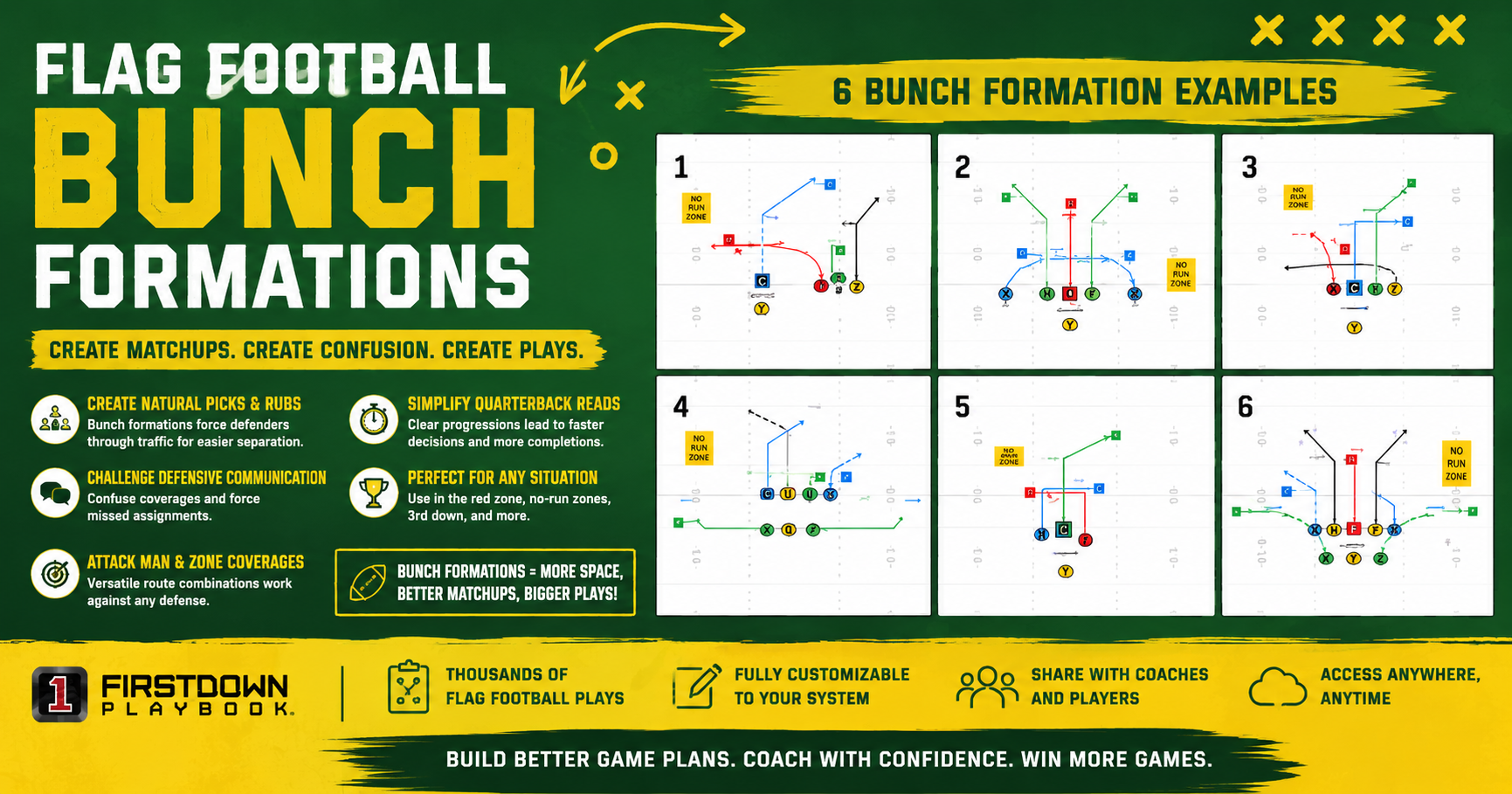
If you've watched successful flag football teams at any level, you've probably noticed one thing they have in common: they use bunch formations. Whether you're coaching 5v5 NFL FLAG, IFAF, 7v7 high school or college girls flag football, bunch formations are one of the most effective ways to create separation, stress defenders, and generate easy completions. Here is a break down on why bunch formations continue to be one of the most popular offensive tools in flag football.
1. Bunch Formations Create Natural Picks and Rubs
A bunch formation forces defenders to navigate traffic immediately after the snap. When receivers release in different directions, defenders can easily get caught behind teammates or lose leverage while attempting to chase their assignment. Depending on your format and league rules, one of the most important rules for the offense in bunch formation is to watch out for the rusher to avoid an impeding the rusher call. Even when coaches aren't intentionally designing a pick route, the congestion created by a bunch alignment often results in receivers gaining immediate separation.
This is especially effective on:
- Quick outs
- Slants
- Shallow crosses
- Pivot routes
- Mesh concepts
The result is an easy throw and catch for the quarterback.
2. Defenses Must Communicate
Bunch formations challenge defenses to communicate quickly and correctly.
Defenders must decide:
- Are we staying in man coverage?
- Are we switching routes?
- Who has the first inside release?
- Who takes the deep route?
One missed call can result in a receiver running uncovered down the field. Many youth and high school defenses struggle with these communication responsibilities, making bunch formations one of the easiest ways to create confusion without requiring complex offensive schemes.
3. Bunch Formations Attack Both Man and Zone Coverage
Great offensive concepts work regardless of the defense being played. Against man coverage, bunch formations create traffic and force defenders to navigate through multiple routes. Against zone coverage, bunch formations flood defenders with multiple receivers entering their area simultaneously.
Popular concepts include:
- Flood
- Levels
- Spot
- Smash
- Mesh
- Switch Releases
These route combinations force defenders to make decisions quickly, often creating windows for easy completions.
4. Quarterbacks Get Clear Reads
Many bunch concepts are designed to simplify the quarterback's progression.
Instead of reading the entire field, quarterbacks can focus on a specific defender or side of the formation.
For example:
- If the flat defender widens, throw underneath.
- If the corner jumps short, throw deep.
- If defenders switch incorrectly, hit the uncovered receiver.
This allows younger quarterbacks to play faster and make better decisions.
5. They Work Well in Limited Space
Flag football games are often won inside the red zone and no-run zones depending on the format. Bunch formations excel in these situations because they create immediate movement and force defenders to react quickly. When space becomes limited, route combinations and timing become even more important. Bunch formations maximize the amount of stress placed on a defense within a small area of the field.
This is why many coaches have dedicated bunch packages specifically for:
- Goal line situations
- Extra points
- No-run zones
- Third-and-short conversions
6. Endless Variations Keep Defenses Guessing
The beauty of bunch formations is their flexibility. Defenses may recognize the formation, but they still have to identify which concept is coming.
The same alignment can be used to run:
- Quick game concepts
- Deep shots
- RPOs
- Motion plays
- Screen concepts
- Crossing routes
The best flag football offenses don't always have the fastest players, they create space. And few formations create space better than the bunch. Looking for bunch plays for your team? FirstDown PlayBook includes dozens of bunch formation concepts for NFL FLAG, IFAF, High School, College, and 4v4, 6v6, 8v8 formats, helping coaches find the perfect play for every situation. Here is an example of a few bunch plays you can find on FirstDown PlayBook: