The growth of NCAA Division I women's flag football is great for the sport. But what happens to the coaches and programs that spent the last six or seven years building it?
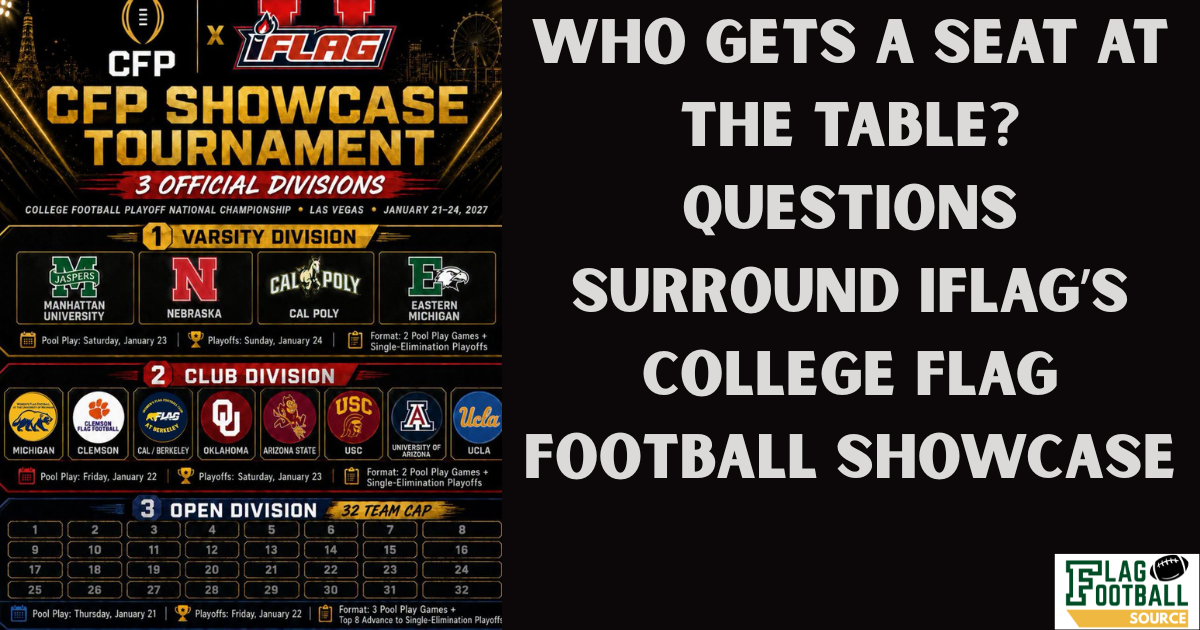
There is no denying that women's college flag football has reached a turning point. The NCAA is moving aggressively toward championship status. More than 400 collegiate club and varsity programs across multiple governing bodies are expected to compete during the 2026–27 academic year. Nearly 150 NCAA varsity programs are expected to compete, alongside roughly 120 NCAA club teams. And now flag football is getting a stage that would have been almost unimaginable a few years ago. The College Football Playoff and iFlag are partnering to host the inaugural CFP Flag Football Showcase in Las Vegas during CFP National Championship weekend in January 2027. The event will put college flag football in front of an audience already gathered to celebrate college football's biggest weekend. That's a tremendous opportunity. But it has also opened up a difficult conversation within the sport.
What Happens to the People Who Built the Foundation?
The initial collegiate announcement featured four varsity programs: Cal Poly, Eastern Michigan, Manhattan and Nebraska. All four are launching varsity programs for the 2026–27 academic year. The club portion initially included Arizona, Arizona State, Cal, Clemson, Michigan, Oklahoma, USC and UCLA. Those are recognizable university names. They will bring resources, athletic departments, facilities, recruiting power and national attention to the sport. Nobody should want that growth to stop, and we truly understand the reason for the highlight. But there is a growing sentiment among some established college flag football coaches that something is being lost in the transition, to not even be invited or recognized caused some commotion.
For years, coaches at NAIA schools, junior colleges and club programs have been building teams from scratch.
They recruited athletes when few people knew what collegiate flag football was.
They created practice structures.
They developed offensive and defensive systems.
They traveled to tournaments.
They convinced administrators that women's flag football was worth investing in.
They coached players who had never played the sport before.
They helped establish what college flag football could look like.
Few examples make the point better than Warner University. The Royals introduced varsity flag football in 2021. Head coach Tim Mimbs took over in 2022 and helped build the program into one of the country's most successful collegiate teams. In 2026, Warner went 24–0. They won the Sun Conference regular-season championship. They won the Sun Conference tournament. And they won the inaugural NAIA Flag Football National Championship. Warner finished the season with a staggering 1,268–118 scoring margin and defeated programs from multiple levels along the way including NCAA Division I Alabama State by a score of 89–7. That isn't a theoretical program. That's an established national champion. Warner has players with national records, All-American honors and years of experience playing the sport. Yet when the initial CFP Flag Football Showcase field was announced, Warner wasn't part of the varsity showcase. Neither were other established NAIA powers such as Keiser, Ottawa or Baker.
UCF is a perfect example for the club division. The UCF Knights Flag Football Club competed as a student-led sport club and made national headlines in 2026 by winning the inaugural Fiesta Bowl Flag Football Classic in Tempe. UCF went undefeated in the event and defeated Florida 19–7 in the championship game. The Fiesta Bowl event itself demonstrated just how much talent exists within the club landscape. Eight NCAA Division I universities participated, but only one of them was competing as a varsity program. The other seven were club teams. That distinction is important. Club does not automatically mean inferior. In some cases, a club program may have years of experience, nationally competitive athletes, dedicated coaching and a championship résumé. And that is where the frustration begins.
The Issue Isn't Division I
This distinction matters. The argument shouldn't be: "Division I shouldn't be invited."Of course Division I should be invited. The arrival of Division I women's flag football is one of the best things that has ever happened to the sport. The issue is whether Division I status should automatically carry more weight than proven flag football success. A program that has existed for one season doesn't necessarily have more flag football experience than a program that has been competing for five or six years. A university with a recognizable athletic brand doesn't automatically have a better flag football team. And a new varsity program doesn't automatically have a better coach than someone who has spent years building an established program. That's the uncomfortable part of the conversation.
The Public Reaction Says Something
The questions aren't coming only from outside observers. Following the announcement, public comments on iFlag founder Charles Davis's announcement directly questioned the absence of NAIA programs. One commenter asked why the NAIA had no teams, pointing out that NAIA programs have been playing the sport the longest and have had championships for years. Another asked whether other levels of the NCAA would be opened up in the future. Those comments aren't proof that every coach feels slighted. But they do demonstrate that the issue is being discussed publicly within the flag football community. And perhaps that is healthy. Because the sport is entering a new era, and the people who have been here from the beginning deserve to have a voice in what that era looks like.
To iFlag's Credit, The Door Was Opened Wider
There is another important piece of this story that shouldn't be overlooked. After the initial announcement, iFlag added a third collegiate division that is open to club and varsity programs from all collegiate governing bodies. That division will be capped at 32 teams, with each team having to pay a registration fee, which also caused some stiff amoung the flag community. iFlag also announced that three events during the next year will provide opportunities for teams to qualify for the 2028 CFP Flag Football Showcase. That changes the conversation. It means the initial field isn't necessarily the final word on which programs matter. There is now a pathway for teams outside the initial Division I showcase to participate. But it also raises another question: Should established programs have to earn recognition through a separate path when they have already earned championships?
This Conversation Is Just Beginning
This is an opportunity for the flag football community to have an honest conversation about where the sport goes from here. How do we support brand-new Division I programs and give them the exposure, resources and opportunities they deserve without overlooking the coaches, athletes and programs that put in the grunt work to build collegiate flag football in the first place? There should be room for both. The future of the sport depends on the investment of Division I schools, but its foundation was built by programs that believed in flag football long before the spotlight arrived. Maybe the answer isn't choosing one over the other, but creating more opportunities for established NAIA and club programs to compete, qualify and showcase what they have built alongside these new D1 programs. What do you think? How can we grow the next chapter of college flag football while still giving credit and opportunities to the people who wrote the first one?