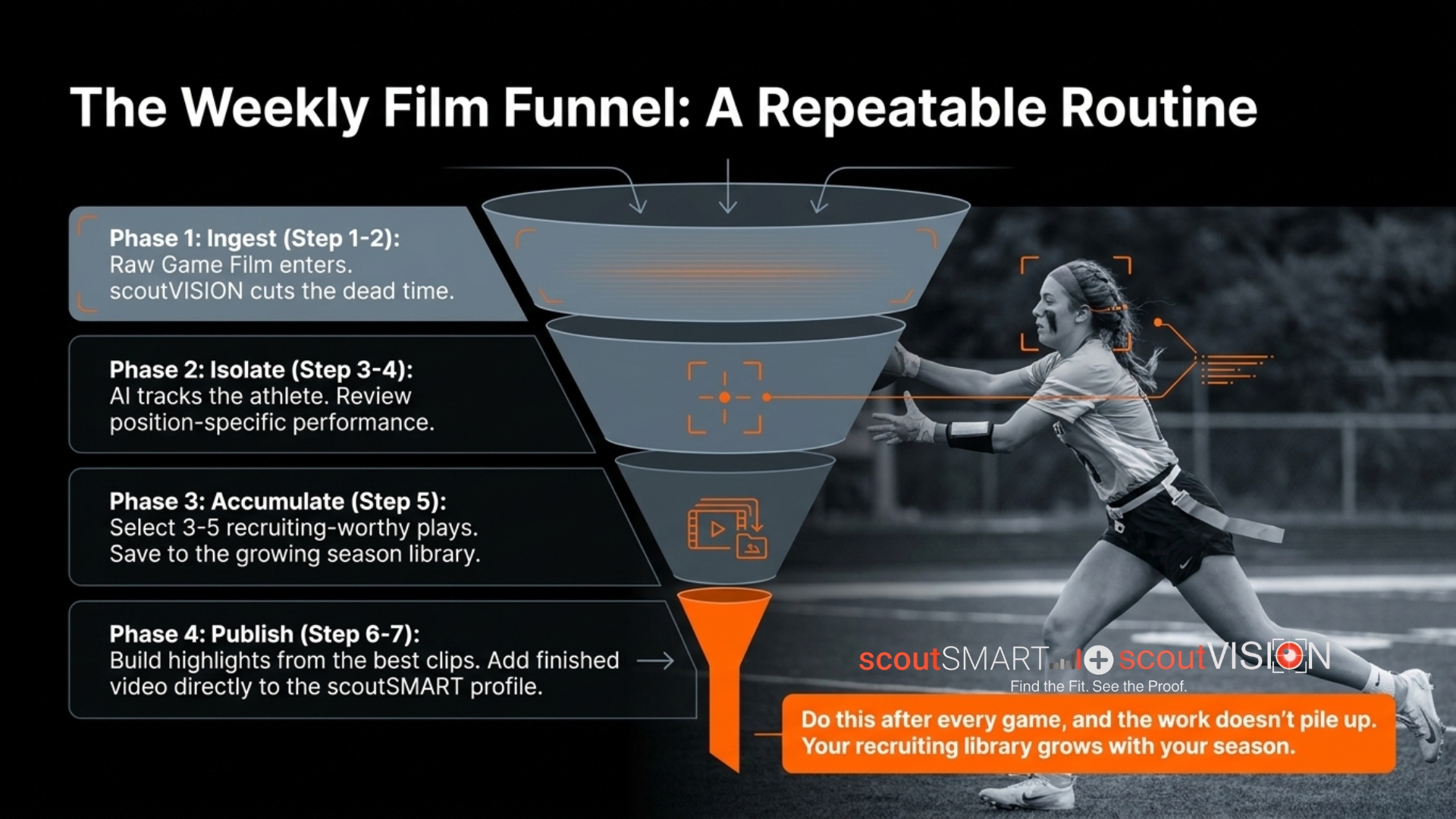
The season is here. The games are being played. The film is starting to pile up. Now what? For student-athletes hoping to play flag football at the college level, September is when recruiting film goes from something you plan to create to something you are actively producing every week.
Every Game Gives you New Material
A great route. A smart read. A perfectly timed flag pull. A pressure that forces a quarterback intoa bad decision. Maybe even a play that never shows up in the stat book but tells a college coach something important about the type of player you are. The key is not waiting until the end of the season to find those moments. Game film should become a weekly recruiting habit. Your season is constantly generating new evidence of your decision-making, technique, speed, versatility and development.
One of the biggest mistakes an athlete can make early in the season is trying to turn Game 1 into a finished recruiting highlight reel. You don't need a final reel yet. You need a film library. Think of it as your recruiting video bank: an organized collection of your best plays that continues growing as the season progresses.
After every game, start asking:
- Did I make a play that demonstrates a position-specific skill?
- Did I do something important that won't show up in the statistics?
- Did I demonstrate awareness or good decision-making?
- Did I play multiple positions?
- Did I make a mistake and respond well on the next play?
- Is this a full game I should preserve?
- Are there two or three plays from this game worth bookmarking? Your goal isn't to save every play. Your goal is to identify the plays that could eventually help a college coach understand who you are as a player.
What College Coaches Look For in Flag Football Film
Can I Clearly Identify This Player:
- Jersey number should be easy to see.
- Start the film by identifying the athlete.
- Use a simple arrow/circle when necessary.
- Don't make the coach hunt for the player.
Football IQ
- Does the player understand the concept?
- Do they know where they should be?
- Do they recognize coverage?
- Do they make good decisions quickly?
- Do they adjust when the defense changes?
Decision-making
- For quarterbacks: reads, timing, accuracy and decision-making.
- For receivers: recognizing space and understanding where to settle or continue a route.
- For defenders: knowing responsibilities and reacting rather than simply chasing the ball.
Speed and athleticism
- First-step quickness
- Acceleration
- Change of direction
- Ability to create separation
- Closing speed on defense
- Ability to make plays in space
Route running
- Releases
- Footwork
- Route precision
- Separation
- Ability to sell a route
- Understanding of leverage and defensive positioning
Ability to catch the football
- Catching on the move
- Adjusting to the ball
- Catching away from the body
- Contested situations
- Getting feet down
- What happens after the catch
Defensive ability
- Man coverage
- Zone awareness
- Flag-pulling technique
- Closing on the ball
- Breaking on routes
- Understanding leverage
- Communication
- Ability to stay disciplined rather than simply chasing the quarterback
Movement without the ball
- How a player runs a route when they're not the primary target
- How they create space for teammates
- Whether they understand spacing
- Whether they continue playing after the ball goes elsewhere
Communication
- Calling out coverage
- Communicating assignments
- Helping teammates
- Defensive communication
- Sideline/field awareness
Competitiveness and effort
- Pursuit after a play
- Finishing plays
- Reaction after mistakes
- Getting back into position
- Playing hard when the ball isn't coming their way
Versatility
- Display the different positions you are able to play
How the player responds to adversity
Coaches can learn from seeing how an athlete responds after:
- An interception
- A dropped pass
- Getting beaten on defense
- A bad play
- A missed flag
Film quality and organization
- Video is clear
- The camera gives coaches enough field view
- Plays aren't excessively edited
- The athlete is easy to locate
- Clips aren't unnecessarily long
- Contact/recruiting information is easy to find
The Biggest Recruiting-Film Mistake
Don't build a film that only proves the athlete can make spectacular plays. Build a film that proves the athlete can play football.
A college coach wants to answer questions like:
Can she play?
Does she understand the game?
Does she consistently make good decisions?
What position can she play for us?
How does she perform when things don't go perfectly?
Can I project her into our system?
Creating recruiting film doesn't have to mean spending hours scrubbing through game footage trying to find your best plays. scoutVISION from scoutSMART can help athletes turn raw game film into recruiting-ready clips by automatically identifying plays, filtering out inactive portions of the game and trackisng the player through the footage. It can help you quickly find and organize the plays that showcase your abilities, making it easier for college coaches to see what you can do on the field. If you want to better understand what college coaches are looking for when they evaluate player film, be sure to watch the scoutSMART recruiting webinar and use the film checklist to make sure your video gives coaches the information they need to evaluate you. Your film is one of the most important parts of your recruiting profile—make sure it tells the complete story of how you play the game.