As flag football continues to grow nationwide-especially with youth, high school, and recreational adult leagues-coaches are finding themselves needing to adapt between different formats. Two of the most common are 5v5 and 7v7, and while both formats share the fundamentals of the game, their strategies and structures differ in critical ways.
Whether you're a new coach or transitioning between leagues, here's what you need to know to game plan effectively for each.
1. Field Size and Space
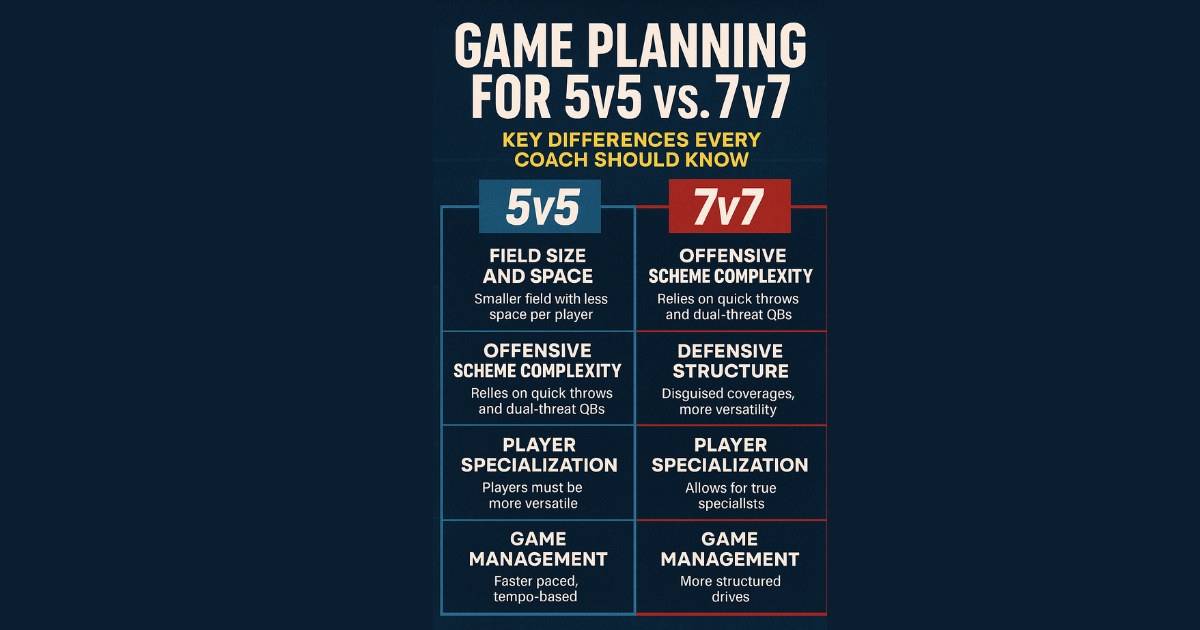
- 5v5 is typically played on a smaller field (25-30 yards wide and 50 yards long), which means less space per player.
- 7v7 often takes place on a wider field (up to 40 yards wide), allowing for more elaborate route combinations and deeper plays.
Coaching Tip: In 5v5, quick passes and short routes thrive. In 7v7, stretch the field with layered route trees.
2. Offensive Scheme Complexity
- 5v5 relies heavily on quick timing throws, option routes, and dual-threat QBs due to tighter space.
- 7v7 opens the playbook to more traditional football concepts-flood routes, vertical attacks, and multiple reads.
Coaching Tip: Use 5v5 to develop timing and spacing; use 7v7 to teach progression and field vision.
3. Defensive Structure
- 5v5 defenses usually run basic zone or man coverages with one safety over the top. Blitzing may be limited or prohibited depending on rules.
- 7v7 defenses can disguise coverage more effectively-running rotations, robber zones, and even bracket coverage.
Coaching Tip: In 5v5, prioritize speed and flag-pulling ability. In 7v7, emphasize communication and pre-snap reads.
4. Player Specialization
- 5v5 often requires players to play both ways and be more versatile.
- 7v7 allows for true specialists-a slot receiver, deep safety, or hybrid linebacker can really shine.
Coaching Tip: Use 5v5 for developing well-rounded athletes. Use 7v7 to plug players into specific roles.
5. Game Management
- Clock management and tempo matter in both formats, but:
- 5v5 games are usually faster paced.
- 7v7 games allow for more structured drives and decision-making.
Coaching Tip: Practice late-game scenarios in both settings to build smart, situational players.
Final Thought
Both 5v5 and 7v7 are valuable for teaching and competing in flag football. Mastering the differences in space, scheme, and strategy between the two will help you develop players faster and win more consistently.
Whether you're coaching a local youth team or competing in national tournaments, adapting your approach to the format is key.